
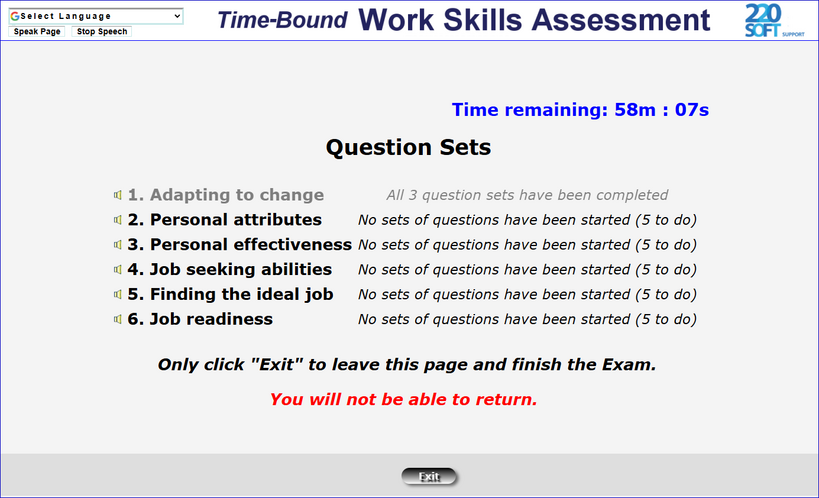
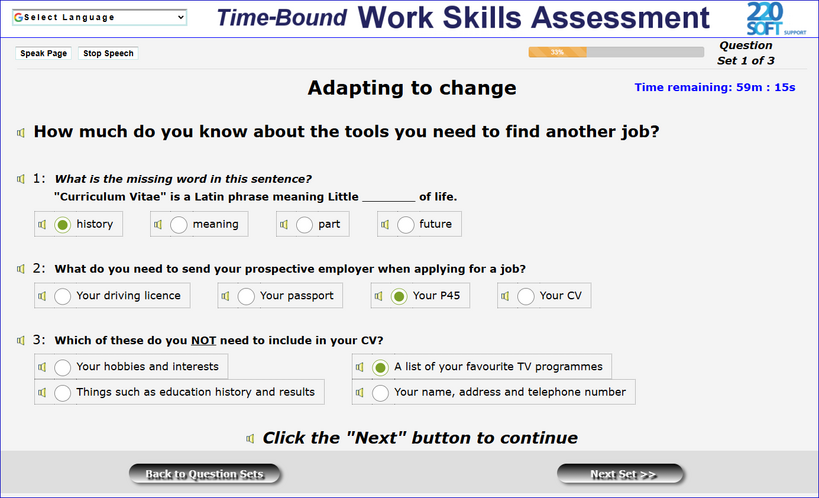
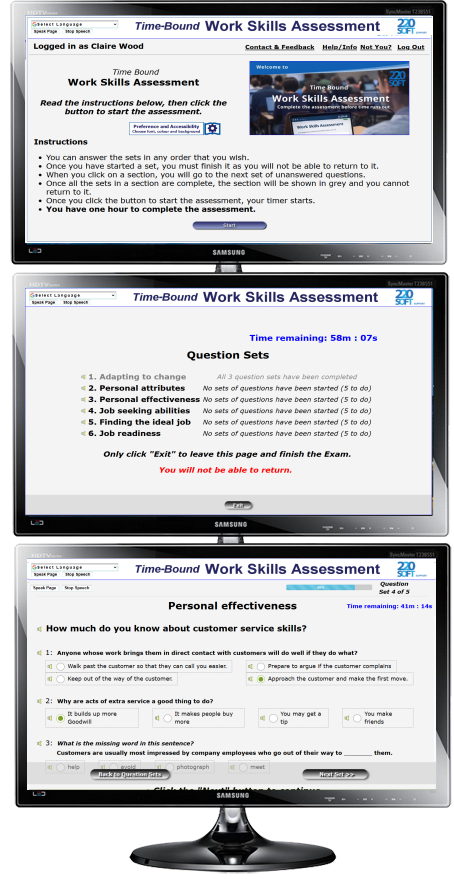
The Time-Bound Work Skills Assessment contains the same questions as the assessment in the product. These are all questions that check an aspect of employment seeking and repeated use helps the user to retain the information.
Each user can take the assessment up to 10 times, although we recommend twice – once before starting training to assess the need and areas requiring most support and then again after training to assess progress (Assess-Learn-assess).
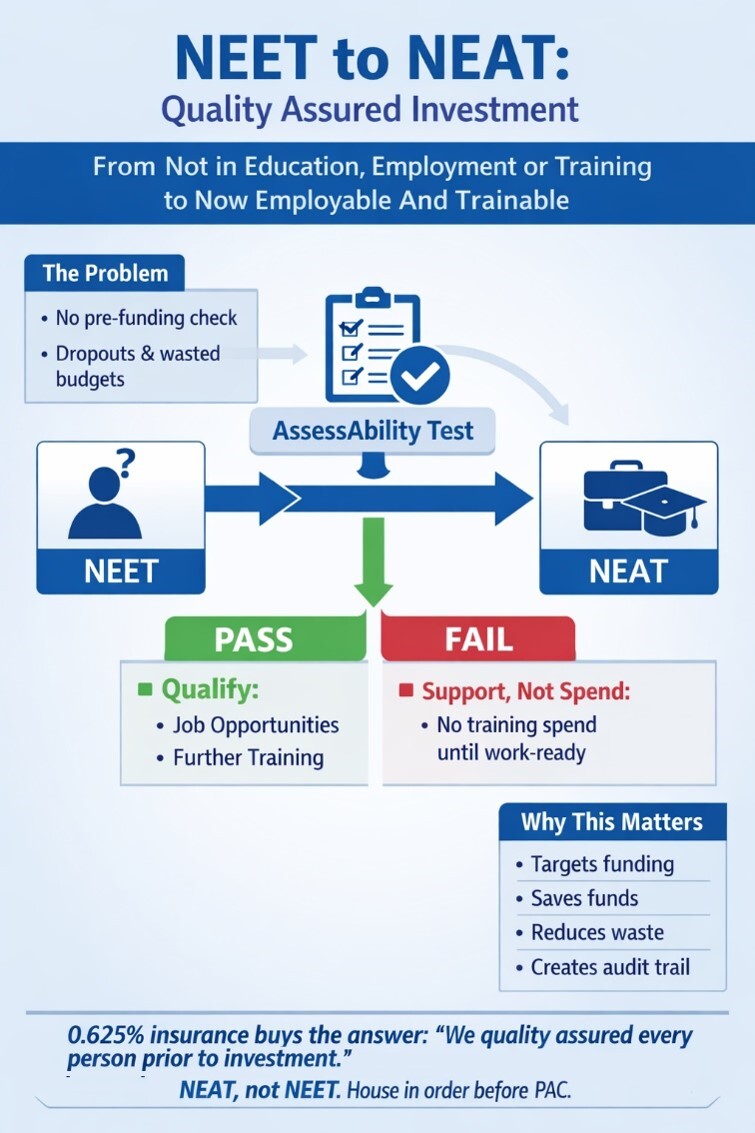
The 220 Soft WorkSkills initiative takes employment seekers from Not in Education, Employment or Training (NEET) to Now Employable And Trainable (NEAT). It’s a Quality Assured Investment.
The Problem
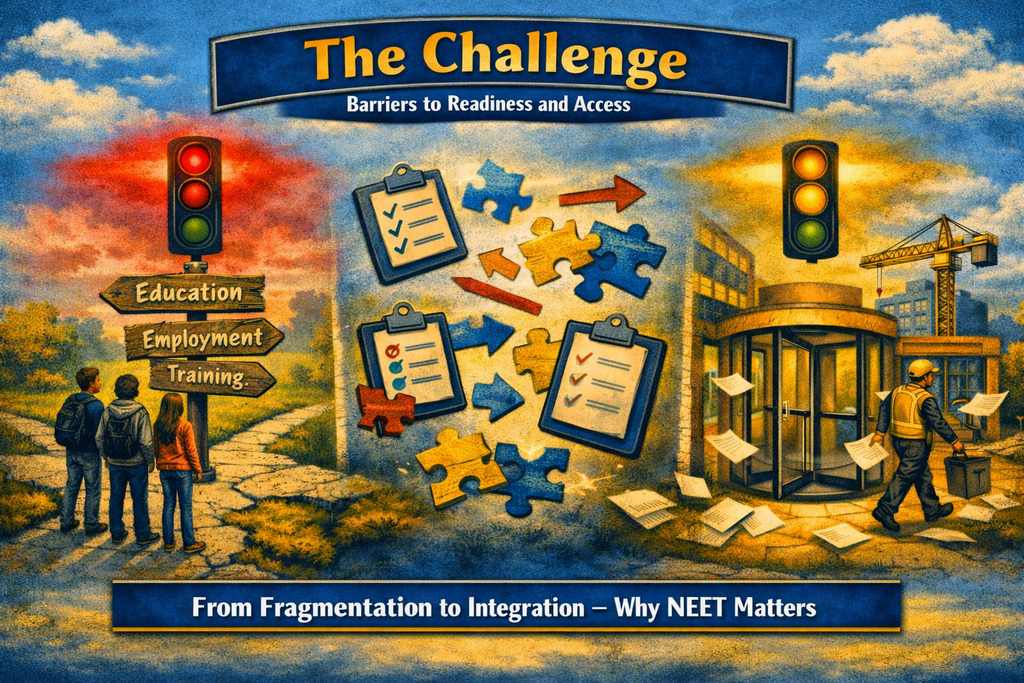
Current welfare-to-work spending lacks a pre-funding quality check. The result: dropouts, poor job entry rates, and wasted training budgets funding people who cannot connect to work.
The Solution: The NEAT Pass Mark
To achieve the transition from NEET to NEAT, beneficiaries must demonstrate a pass mark in the assessment. This pass shows measurable progress on their journey from welfare to work.
Pass = Qualify
If a person passes, they qualify for:
1. Job opportunities, or
2. Further training, funded from the training budget
Fail = Support, Not Spend
No pass means that there is no training spend until they are work-ready. This prevents funding people who cannot benefit.
Why This Matters
1. Targets funding at people who can benefit most
2. Saves valuable funds by stopping spend on those not yet ready
3. Reduces waste from assessment dropouts and failed placements
4. Creates an audit trail proving beneficiaries were NEAT before any funding is allocated
The Alternative
If there is no assessment there are dropouts, poor job entry rates and £millions wasted. PAC will ask: “What checks did you do before funding?”
0.625% insurance buys the answer: “We quality assured every person prior to investment.”
NEAT, not NEET. House in order before PAC
The Time-Bound WOrk Skills Assessment mirrors the questions found in the learner guide but is delivered as a timed test in which each question may be attempted only once. This format gives a reliable snapshot of current knowledge, discourages repeated guessing, and supports meaningful pre/post comparisons. Repeating assessments across the learning cycle also improves long-term retention.
How the learning cycle works
This Assess - Learn - Assess sequence is designed to improve outcomes by focusing effort where it will have most impact and by providing clear evidence of development.
We recommend the two uses of the timed assessment, as it gives the clearest measure of learning, but additional attempts (up to 10 in total) may be used for practice or refreshers.
Key benefits
Reliable measurement: Timed, single-attempt questions reduce score inflation and make pre/post comparisons meaningful.
Targeted learning: Embedded assessments in the guide help learners concentrate on the areas that need the most support.
The following topics are all tested in the Time-Bound Assessment:
Adapting to change
Personal attributes
Personal effectiveness
Job seeking abilities
Finding the ideal job
Job readiness
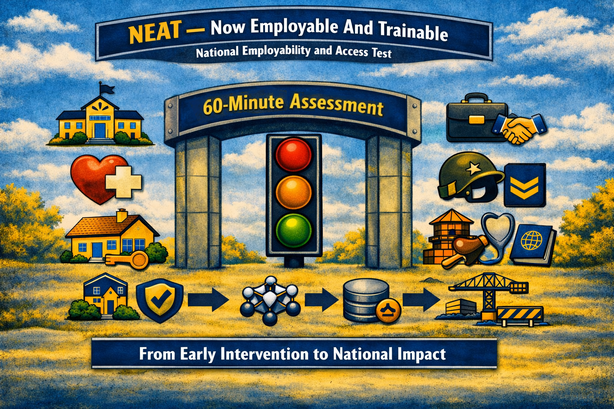
Following are just some originations that can benefit from the NEAT (Now Employable And Trainable) Gate. The 60-minute assessment gives a gate to multiple applications for £25.
Core Principle: Any organisation that spends money, manages risk or safeguards reputation before a person is “ready” benefits from a standardised readiness gate. NEAT = turn up, speak up, stick it. If that fails, everything else fails.
1. Department for Education – Schools & Alternative Provision
Why: Persistent absence, exclusions and post-16 NEET flow start with lack of preparation.
Benefit: 60-min NEAT check at Year 10/11 flags disengagement before GCSEs fail. A red flag allows targeted pastoral/attendance support. Prevents £400k lifetime NEET cost at source. Aligns with Attendance Hubs policy.

2. Further Education & Apprenticeship Providers
Why: 30-40% apprenticeship result in non-completion. The main cause is work-readiness, not technical skill.
Benefit: NEAT gate before enrolment or levy draw-down. Protects £15k-£27k public funding per apprenticeship. Improves Ofsted “behaviour & attitudes” grade. Employers get ready apprentices.

3. Higher Education Institutions
Why: First-year dropout costs £9,250 fee + £10k maintenance + reputational damage. Often non-academic.
Benefit: NEAT as part of contextual admissions or enrolment. Identifies students needing resilience/support services before they fail. Reduces £50k+ write-offs per student. Improves TEF metrics.
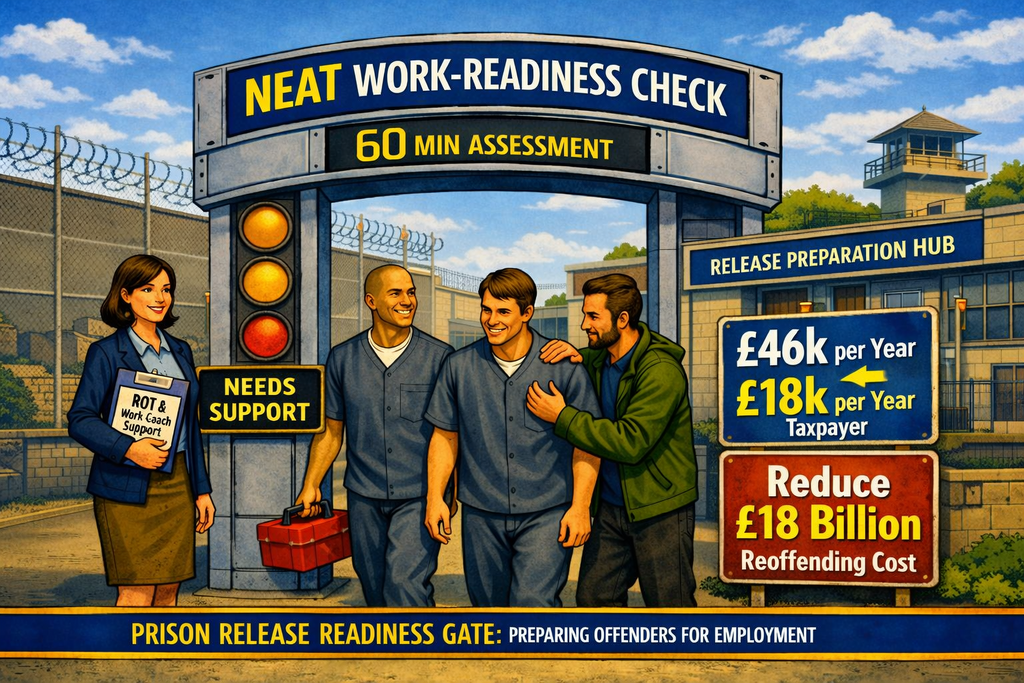
4. Ministry of Justice – Prisons & Probation
Why: Re-offending costs £18bn/year. Employment on release cuts reoffending by 9%. But 60% aren’t work-ready.
Benefit: NEAT gate 6 months pre-release. Poor results allow targeted ROTL/work-coach support while good results allow release on licence with job lined up. Turns £46k/year prison cost into £18k/year tax contribution.

5. Ministry of Defence – Armed Forces Recruitment & Resettlement
Why: Basic training attrition 15-20%. £35k+ cost per recruit lost. Resettlement fails when veterans lack NEAT.
Benefit: NEAT gate pre-enlistment and pre-discharge. Reduces wastage, improves retention, cuts veteran unemployment. One standard from barracks to civilian job.

6. Home Office – Immigration & Asylum Support
Why: Right to work granted without readiness check. Leads to exploitation, destitution or benefit dependency.
Benefit: NEAT as part of “integration gateway” before work permission or move-on support. The assessment proves ability to sustain employment. It reduces demand on local authorities and supports “contribution” narrative.
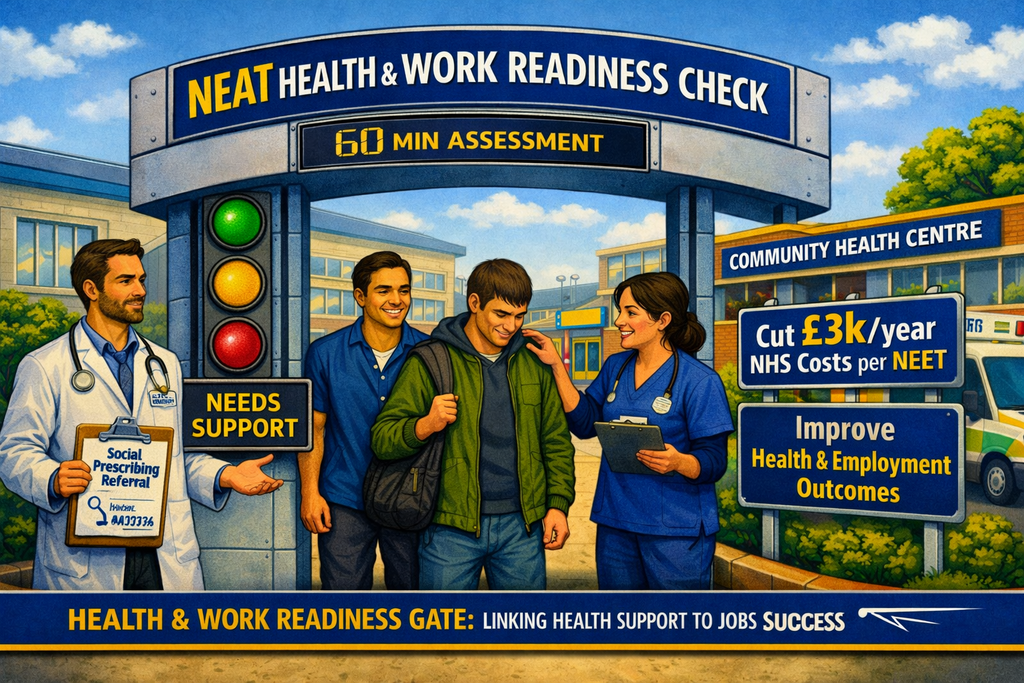
7. NHS & Integrated Care Systems
Why: Worklessness drives 30% of health inequalities. Depression, obesity and substance use. Each NEAT could save £3k/year extra NHS cost.
Benefit: Social prescribing link. GP/Jobcentre can refer to NEAT check. Red = health + employment coach. Green = Jobs Guarantee/health-sector role. Cuts demand, improves population health outcomes.
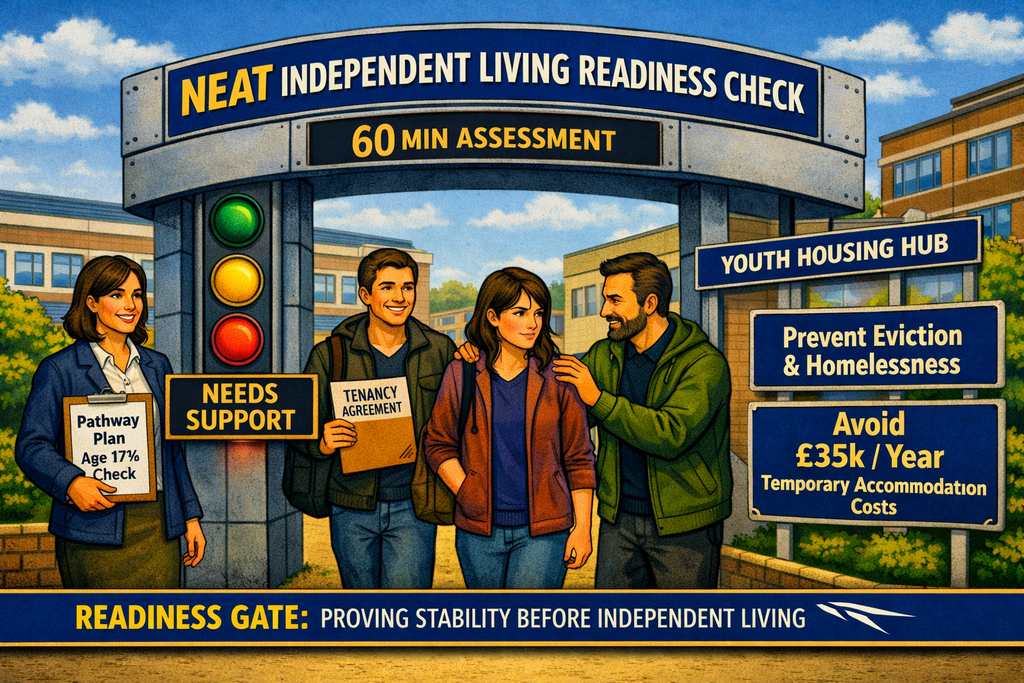
8. Local Authorities – Children’s Services & Housing
Why: Care leavers 41% NEET at 19-21. Housing tenancy failures linked to worklessness.
Benefit: NEAT gate at 17.5 as part of Pathway Plan. Must-pass before independent tenancy sign-off. Red = staying put + support. Prevents eviction, homelessness and £35k/year TA costs.
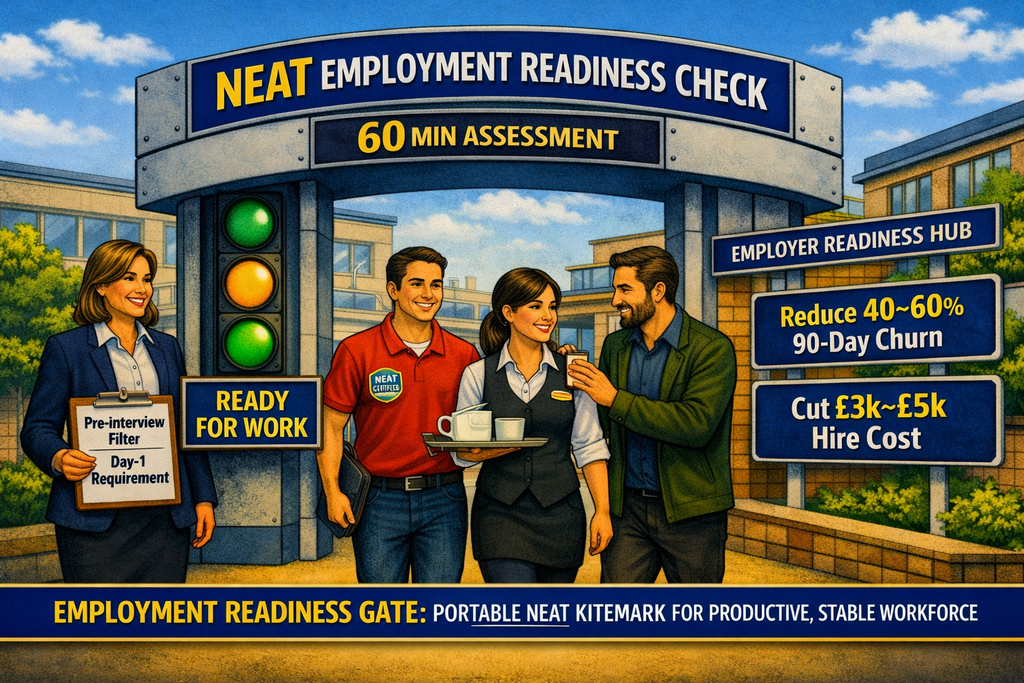
9. Private Sector Employers – High-Churn Sectors
Why: Retail, hospitality, logistics, care: 40-60% quit in 90 days. £3k-£5k cost per hire.
Benefit: Employers adopt NEAT as pre-interview filter or Day 1 requirement. Reduces churn, cuts agency spend, improves productivity. Candidates bring portable NEAT Worklessness – like DBS or CSCS.
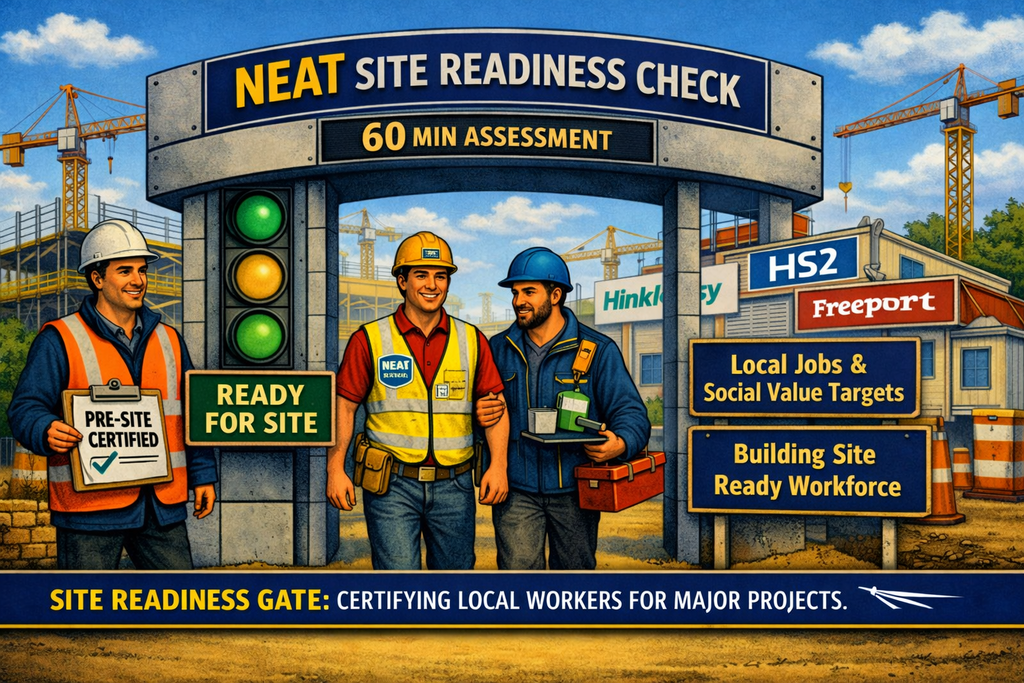
10. Prime Contractors – Major Infrastructure Projects
Why: HS2, Hinkley and Freeports have “local labour” clauses. Social value targets are missed due to unreadiness.
Benefit: NEAT is a universal pre-site standard. Funded by contractors and mandated by contract. De-risks S106 obligations. Stops local recruitment from becoming local PR disaster.
Purpose
The Challenge
The NEAT Solution
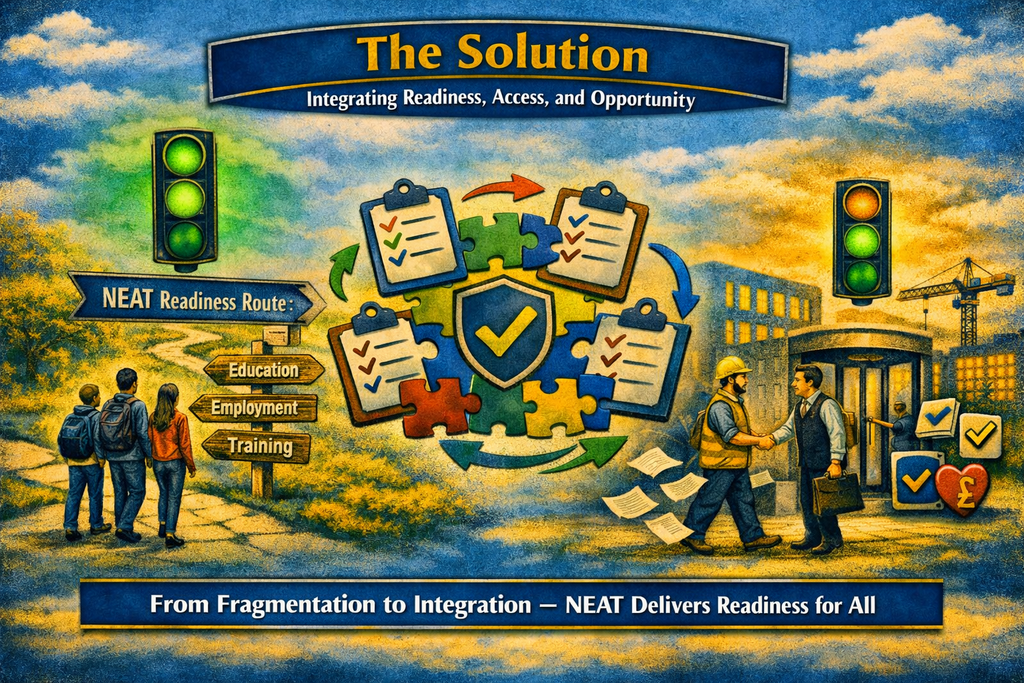
NEAT introduces a standardised 60‑minute assessment that measures practical, emotional, and situational readiness. It acts as a gateway before key transitions:
Sector | NEAT Gate | Benefit |
Schools & Colleges | Pre‑16 readiness | Early identification and support |
DWP / Jobcentre | Referral gate | Targeted interventions before placement |
NHS & ICS | Health‑linked gate | Aligns wellbeing with employability |
Local Authorities | Housing gate | Prevents tenancy failure and homelessness |
Employers | Day‑1 gate | Reduces churn and recruitment cost |
Prime Contractors | Site gate | Certifies local labour readiness |
How It Works